Why Read the Bible - John Piper
Information technology seems plumbing equipment that John Piper, founder and teacher of desiringGod.org and chancellor of Bethlehem College and Seminary, would publishReading the Bible Supernaturally: Seeing and Savoring the Celebrity of God in Scripture at this point in his writing ministry. Nearly every thread of his ministry distinctives is woven into this volume that exalts the divine source of these now well-known emphases. Christian hedonism, worship, missions, the necessity of rigorous thinking for the sake of the angel, prayerful dependence on God, and even a few of his more pop acronyms are brought together in a volume on reading Scripture well. You can encounter this in the style Piper frames and unfolds the purpose of Bible reading:
Our ultimate goal in reading the Bible is that God'south infinite worth and beauty would be exalted in the everlasting, white-hot worship of the blood-bought bride of Christ from every people, linguistic communication, tribe, and nation.
Piper unpacks this definition over the book's first 10 chapters, emphasizing the need tosee God's glory in Scripture through careful, cogitating reading and tosavor this glory for the sake of personal transformation. To Piper, beholding God'south worth and beauty in Scripture is the non-negotiable aim in all Bible reading. "There may be a hundred applied reasons—good ones—that we plough to God'south Give-and-take," he writes. "This aim [of seeing God's glory] should be in and under and over all of them—e'er" (66).
Natural Act, Supernatural Result
Piper builds a biblical case for why Scripture must exist read supernaturally. In short: without God'south Spirit graciously removing our spiritual incomprehension and softening our hearts, we tin neither grasp the significant of the biblical text nor run across the dazzler of what is there. God-dependent prayer and humility, and so, become essential for reading Scripture as God intends it to exist read. To those who cry out continually for help, God grants wisdom and grace (meet Ps. 119:12, 26, 33, 125; Prov. ii:1–viii).
But if we approach the holy text with the unclean feet of pride and self-reliance, nosotros will encounter divine opposition (Jas. 4:vi). We volition feel this opposition in our inability to rightly construe the meaning of a text, or in our incapacity encounter God's beauty in information technology, or in both (consider Jesus's indictment of the Pharisees in John v:39–44). Of class, even humility is a souvenir of grace, and then our dependence is absolute.
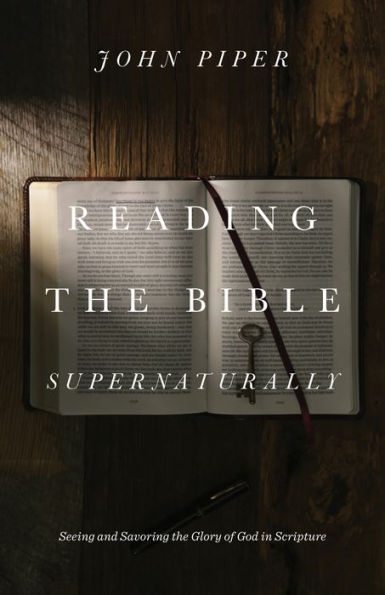
Reading the Bible Supernaturally
Reading the Bible Supernaturally
John Piper
Still seeing what is actually there involves more than just humble prayer and the hope God volition reveal the riches of his Discussion through a few cursory glances:
When we pray for God to bear witness us his glory in the Scripture we are not asking him to bypass the significant of the text, simply to open up the fullness of the author'southward meaning. . . . . [W]hen the Psalmist prayed, "Open my eyes that I may behold wonderous things in your police," (Ps. 119:18), he did non hateful that the sight of wonders could skip the natural process of conscientious reading. (262–63)
Past giving usa a divinely inspired book, God has ordained that we grasp the fullness of the Word'south meaning through dependence on Christandthe use of natural means. As we labor to discover a text'southward meaning, nosotros're to give careful attending to words, grammar, sentence construction, logical arguments, and context. We must acquire to ask proficient questions of the text and think carefully over how seemingly incongruent truths from unlike sections of Scripture fit together in a seamless unity. Piper has called this rigorous, God-reliant reading of the text the "natural human activity of reading the Bible supernaturally," and he provides insights that'll help both new and seasoned saints do this better.
'I Prayed Virtually It' Is Non Plenty
But prayer doesn't make us infallible. While essential for rightly understanding and savoring biblical truth, prayer doesn't guarantee nosotros'll go everything right. Yet how frequently is this implied when, in the moments merely earlier someone discloses how their study of Scripture led them to embrace an aberrant doctrinal position, they report how diligently they "prayed" over the text, equally if that settled the upshot? Piper argues:
Nosotros cannot make a instance for our interpretation past challenge illumination in answer to prayer, because the mode God illumines the text is byshowing what is really at that place. This means that when nosotros want to make a example for how we empathize a text, nosotros must show what is actually there. One good, solid grammatical argument for what the text means outweighs every exclamation that the Holy Spirit told me the meaning. The reason that statement is not irreverent is that it takes more seriously the glorious work of the Holy Spirit in inspiring the grammar than information technology does the subjective experiences of an interpreter who ignores it. (264)
Our prayers, then, should exist that God non but testify u.s.a. his glory, but that he do then through what is really in the text. When others signal out the deficiencies in our interpretation and offering reasonable insights, we should take these corrections as an reply to our prayer for God's help. Ameliorate to be teachable and see more glory than to appear pious ("I prayed well-nigh information technology") and miss out on all God has for united states in Scripture.
Meaning of Meaning (and Experience)
Piper charts a particular hermeneutical form throughoutReading the Bible Supernaturally. You'll not discover whatever sympathy for modern linguistic theory in these pages.
The biblical text has an objective meaning grounded in authorial intent that must exist discovered—not created—by the interpreter. Our experiences are vital, to be certain. But rather than shifting pregnant from the author to the reader, our experiences serve to shed light on what is considerately in the text. That's why the psalmist could say, "It was good that I was afflicted,that I might larn your statutes" (Ps. 119:71, emphasis added). For the psalmist, and for all diligent Bible readers, experience—and the experience of suffering in detail—will frequently open vistas in Scripture that would've otherwise remained unseen.
[Sentinel this TGC video as Don Carson, Tim Keller, and Piper hash out how "a thousand sorrows teaches a human to preach."]
Merely I Don't Feel It!
Piper recognizes that this fashion of framing the practise of Bible reading may exist strange to some, if not many, Christians. Bible reading is often viewed as a duty to exist scheduled and fulfilled rather than a feast to be anticipated and enjoyed.
Bible reading is often viewed every bit a duty to be scheduled and fulfilled rather than a feast to exist anticipated and enjoyed.
While not removing the need for personal field of study, Piper draws united states of america deeper into the realm of desire. It's true believers won't always feel like reading and studying Scripture, just that'southward why the psalmist begs God to "[i]ncline my heart to your testimonies and not to selfish gain" (Ps. 119:36). Our battle for obedience is fought, equally Piper observes, primarily "at the level of desire, non deeds" (254).
Want for God's Discussion is essential, not optional. So our daily cry must be for God to maintain and increase our inward longing for his Word, which will, in turn, strike a decisive blow against the many things that tin can asphyxiate out the Word and endanger our perseverance (254).
Great for Discipling
Nigh three-quarters of the way through I decided that, along with Scripture, I was going to utiliseReading the Bible Supernaturally equally one of my chief texts to disciple men in our church. I tin can't think of a more important job than helping other Christians read their Bibles well.
And to read the Scriptures well, we must seeand savor the divine glory revealed on its pages. When this happens, we will be transformed into the epitome of Christ (1 Cor. three:eighteen) and be equipped for every good work (two Tim. three:16–17).
That sounds pretty comprehensive, and information technology all comes from learning how to read the Bible supernaturally.
Source: https://www.thegospelcoalition.org/reviews/reading-the-bible-supernaturally-john-piper/
0 Response to "Why Read the Bible - John Piper"
Post a Comment